Sunday, May 25, 2008

Films on 5/25/08

Down and Out (1971) National Safety Council/Journal Films
Depicts falling as one of the most common causes of injury in a shop situation, and examines the common hazards which cause people to lose their balance, such as over-reaching, taking short cuts, failure to check equipment and not looking where one is going. This is one of my top ten favorite films. It has a great drum soundtrack and the guy just keeps falling over and over and over...

Portrait of a Vandal (1978) Centron Tells the true story of three young boys who vandalize a classmate's home. Shows the effect on the boys and their parents. Wow, they totally wreck the little girl's room. It seems like everybody enjoyed trashing the house.

Collective Behavior - Civil Disturbances - Part I - Evolution of Disorder and Crowd Psychological Factors (1975) U.S. Army.
This film was made for military police and soldiers on what causes civil disturbances and riots. A fairly enlightened film considering it was made by and for the Establishment. Lots of footage of demonstrations and rioting during America's late 1960s. The still on the left was from a Yippie rally and is a quote from Ed Saunders (The Fugs). I got this film on Ebay, but ultimately I'm looking for another film - Civil Disturbances - Principles of Control (1968).

From Rugs To Riches (1960) Thomas Craven/Caprolan
Made for carpet salesmen, madcap Jonathan Winters shills Caprolan acrylic carpeting with a variety of characters. Some of the bits work and others fall flat - like another internal sales film that audiences hate (but I love) Freeze-In. The color is bad on the film, but I'll try and get it online soon.

Ins and Outs of the Diaphragm (1976) Crommie And Crommie
Follows a woman who no longer wishes to use birth control pills as she visits a nurse-practitioner to be fitted for a diaphragm. Explains, through the course of the visit and the questions of the woman, what the diaphragm is, how it works and how it is inserted and removed. Nothing left to the imagination with this film. We see a cervix and how the diaphragm is inserted and removed from the vagina(!). Films that explicitly show how to use birth control are rare (mostly Army films made for men) - so this is quite a film.

But If You Live... (1982) Kemper
Focuses on high school students' attitudes towards driving and drinking. Features interviews with teens who survived DWI accidents but were left permanently disabled. Provides another perspective through a parent who lost a teenage daughter. I let folks pick a film based on titles. They picked this film over Johnny Boy, Silent Upstairs and Companions. Besides the wretched 1980s clothes and hair, this film was a downer - probably shown to high school kids the week before prom.

Family Talks about Sex (1977) Wexler Film Productions, Inc
Stresses frank family discussion about sex. Suggests that if parents frame their statements about sex around their own beliefs and that if the parent/child relationship is founded on love, respect and trust, then the child will be able to make responsible decisions about sex. A pretty progressive film but not as visionary as Parent to Child About Sex (1967) which addresses much of the same topics. This film did share a common thread that we found in Portrait of a Vandal and But If You Live... - little girl's bedrooms with canopy beds and funky headboards.

Sunday, May 18, 2008

Testy Testy

In honor of our nation's dedication to End of Grade testing, we presented an evening of odd films about tests, testing and various quizzes.

Your Study Skills - Taking Tests (1977) Coronet
Struggling test-taking students write to newspaper columnist Betty Bright, asking specific questions about taking tests and getting useful answers. Cheerful Betty responds with workable suggestions to help them in estimating their test time, sticking to the point, following instructions, and dealing with multiple choice, essay, or true-false questions. It has a great beginning soundtrack and the advice isn't so bad.

You Bet Your Life (circa 1948) Crawley Films
Sponsored by Molson's Beer, this Canadian film is set up like a quiz show. Our Emcee is Stan Francis (you may know him as the voice of Santa Claus in Rudolph the Red Nose Reindeer)who appears in a cap and gown - reminiscent of some of the early TV game shows. We learn of Dorian and see over twenty examples of why he is a reckless driver. Then a police officer politely tells us that auto accidents are on the rise and why alcohol and gasoline don't mix.

Giving The Rorschach Test - Klopfer Method (1951) Central New York University Film Unit
Presents a brief outline of the Klopfer method of presenting the Rorschach test with a single subject. In one inkblot, our nervously timid test subject thinks he sees a bat or Halloween mask or a naked woman with her arms up in praise. Another inkblot is interpreted as two Scottie dogs fighting with blood dripping from their paws. Finally, the subject describes an inkblot as two waiters bowing to a red butterfly. Oh and there are some monkeys too...

SMPTE
Color TV Test Film #2 (1965) Society of Motion Picture and Television Engineers

A test film for film labs to ensure that TV color camera equipment is correctly calibrated. Unfortunately, thanks to Kodak's Eastmancolor film stock, the colors are slowing fading to red. Still there are some great shots of glamorous models walking through once vividly colored sets. The best shot is of a housewife in the kitchen with a big tray of beef.

The Handtrap Test (1966) U.S. Steel / Matt Farrell
Zeros in on finger and hand safety, showing viewers some very valuable tips on how to protect their fingers and hands. Studies the causes of hand injuries. An audience participation film to guide industrial employees in the prevention of hand and finger injuries. Alan Edwards hosts this and provides some comic relief - especially when he reveals that there's a small steel trap in his desk drawer.

Comparative Tests On A Human And A Chimpanzee Infant Of Approximately The Same Age, Part 2 (1932) Pennsylvania State Univ. Psych. Cinema Register

Compares the reactions of a normal human infant between the ages of 10 and 14.5 months to psychological tests, and the responses of a chimpanzee companion, age 7.5 to 12 months, to the same tests. Brings out the effects of different rates of growth and learning abilities and illustrates the capacity of the animal to outdo the child in many tests. Includes hand preference, startle reaction time, delayed reaction, cap-on-head, detour, tickle, ice and rotation test. I commented earlier about this film and every time I watch this it gets better. It is quite a crowd pleaser as well.

Sunday, May 04, 2008

Films on 5/4/08


VD: A New Focus (1971) American Educational Films
Hosted by James Brolin (who was playing the hip doctor on Marcus Welby, MD). Presents an entire picture of the VD problem, giving medical facts, and probing the myths and attitudes of young people concerning VD that often prevent prompt treatment. The obligatory white coated doctor is Stephen Sacks, MD (who looks to still be practicing in the Los Angeles area) whose eyes slowly scan the cue cards as he reads his lines. The best part of this film is the dramatic sequences where the teens confront the possibility of having VD. Like most VD films from this time period, there is no mention of prevention (condoms).

Insight: Just Before Eve (1978) Paulist Productions
Presents a revised version of the Biblical story of creation. Shows how God answers Adam's prayer for another human being after providing a checker-playing angel who is too perfect and a dog which cannot understand him. (Stars Martin Sheen as Adam, Flip Wilson as God, Henry Proach as Angel Josh and very briefly appearance of Darleen Carr as Eve). I knew about the Paulist Insight series from other films in my collection but I saw an excellent overview of the films by Mark Quigley & Dan Einstein of UCLA at the 2008 Orphans Film Symposium at NYU. I immediately started scouring Ebay for films from the collection. This film looked to be good, I mean, Flip "The Devil Made Me Do It" Wilson as God? My mind reeled at the possibilities, but, alas, the film isn't so great. The simplistic dialog ruined it and Flip was just reading lines. Todd Morman commented that it was like an Sunday School class play. I'm on the lookout for "Clowns of Freedom" where Martin Sheen plays an imprisoned clown.

They (1972) Phoenix Films
Wow, this film was a mess! A little boy and a grabby hippie teen talk about the two types of people "We" and "They". "They" are the enemies who live on the other side of the river. Occasionally "We" and "They" battle - throwing spears at each other, taking the lives of children (shades of "Dead Birds"). Then there are the "Outs" who live on an island and are often washed away by floods. Eventually we all figured out what the film was about (that we are all part of the "We" group if we accept the "Theys".) but it was so muddled with symbolic gestures and pointless, annoying dialog.

Blues Maker (1969) Christian Garrison/Univ of Mississippi
Shows Mississippi blues singer, "Mississippi" Fred McDowell, singing and talking about his blues. Includes scenes of the area which helped to shape his country blues. Everybody was blown away by this documentary short which mostly had Fred playing and singing with shots of living in rural, cotton-dependent Mississippi.

Data Processing (1981) Gallaudet College
Captioned for the deaf. Explains data processing and shows range of jobs from Data Entry Operator to Programmer. Features three hearing-impaired people successfully building careers in this field. This is the second film that I have about hiring the hearing impaired to do computer work - during a time when computers were big and loud.

Inside-Out: How Do You Show (1972) Agency for Instructional Television
Presents three boys who express or withhold their feelings about various things that happened to them in the course of an afternoon. Points out the many ways that feelings can be expressed. In one day, this group of boys horse around in a rickety school playground, get mugged by older boys, break a bunch of bottles, hit a homerun during baseball practice, run scared through a cemetery, fight each other while wearing trash cans on their heads and sneak chocolate cake from under Mom's nose. Ah, to be a kid again in the 1970s!

Sunday, April 27, 2008

How To... How To...


Cooking Frozen Beef - USDA
Shows housewives how to cook frozen beef (steak, beef rib roast, hamburger patties, stewed beef). Narrated by a faceless self-assured woman who we can only assume is our nation's Home Economist General.

How To Get Cooperation (1950) Coronet Films
Explains the need for a variety of methods of securing cooperation. Shows how desired ends can be reached more easily with cooperation of others. But I really like this film because it centers on recruiting members for the student audio-visual engineers club (a.k.a. a/v geeks!). Ed is so excited because the new 16mm projectors have arrived, but he has a lot learn about recruiting. The physics teacher helps Ed figure out that the soft approach works best than a blunt one.

How To Be A Friend (1977) Alfred Higgins Films
Friendship requires an active process of involvement and growth because it involves trust, respect, and sharing. It requires effort to make friends, to keep friends, and above all, to be a friend. Explores qualities which help to create rewarding friendships, such as trust, shared interests, supportiveness and candor. Lots of girls with wings and each scenario in the film is punctuated by a Judy Collins-esque two line song about friendship.

How To Conduct Yourself In School (1985) Sandler Films Inc
Depicts consequences of careless behaviors in school and at play. Two student ambassadors very dryly inform us to behave in school, and whatever you do, DON'T DAMAGE SCHOOL PROPERTY.

Talking with Your Teenager about VD (1974) Glen West Films
Shows parents effective ways of communicating with their children. Includes teenagers discussing communications with adults in general and the subject of VD in particular. Features a leading public health official who presents information about venereal disease. The film is an encounter group with teenagers talking about how they can't communicate with their parents. This group is very awkwardly inter-spliced interview with a doctor who awkwardly describes VD transmission, symptoms, treatment. For example, the doctor points to an illustration of a woman's reproductive organs "This is a woman who has been cut in half."

The Shoplifter (1964) Highway Safety Foundation
Shows in detail techniques used by amateur and professional shoplifters and explains how alert employees can prevent thefts. While this film was made for retail employees, the film really is a how-to for potential shoplifters. The biggest hauls are made by women who can carry up to 25 pounds of meat, cigarettes, typewriters or shoe polishers under their dresses. If you are a store owner, its hard not to watch this without assuming that everyone is your store to steal from you...

How to Build an Igloo (1951) National Film Board of Canada
A demonstration of igloo building in Canada's far north, showing how the site is collected and how blocks of snow are used. Presents a step-by-step demonstration by two Eskimos of how to build an igloo, showing how the site is selected and how blocks of snow are used to make a snug shelter against the Arctic cold. Explains why the snow must be carefully chosen, why the blocks are built up in a spiral and how an igloo is ventilated. An awesome film! Available at the National Film Board site.

Sunday, April 20, 2008

Films on 4/20/08

Paris (1952) United World Films/Castle Films
A travelogue of Paris with all the postcard scenes of Paris. Everyone was confused by the adult content in the film (lots of French drinking and smoking). I reminded everybody that Castle Films distributed films primarily to homes with 16mm projectors.

Magicians of India (1947) Official Films
Pictures a series of strange feats performed by the fakirs or magicians of India. Includes the Indian version of the shell game, a snake charmer, a trained goat and a man who lifts a stone with his eye-lids. I've got a pretty jaded bunch that watch films and they weren't buying most of these magic tricks. The best scenes were the trained goat that balanced on a tiny peg that was probably three inches in diameter and the guy who lifted stones with his eyelids. This reminded me of a great Penn and Teller DVD, Penn & Teller's Magic and Mystery Tour, were the duo watch street magicians in China, India and Egypt.

Lost in the Mish-Mosh (1972) Davidson Films/Xerox Films
Tells how a famous detective (a Sherlock Holmes knockoff) selects the appropriate unit of measure in order to save a kidnapped professor. I was hoping that this film would be as good as "Weird Number" - a great film about fractions by Davidson Films. What a let down. Everybody hated the animation and the story was muddled like many math films. Alas...

It's A Cat's Life (1957) Frith Films
Presents information about cats and kittens, such as their habits and how to care for them. Josh pointed out that the camera work was a little lazy and amateur. Emily Frith was an amateur filmmaker who marketed her films to schools in the 1950s and 1960s.

Debt to the Past - Language and Communication (1962) Moody Institute of Science
Depicts such varied means of communication as spoken, unspoken and written language. Presents the pictographic, ideographic and phonetic stages of written language. Discusses the history of the alphabet and demonstrates the power of language for good and evil. I co-wrote an article about the Moody Institute of Science with NCSU film professor "Something Different in Science Films", so there is a lot to say about the company and their controversial films. MIS released many visual stunning films with science content and a religious hook ending ("could this complex biological system haven happened by accident") taking a jab at evolution. This film is not quite as controversial since it deals with the history of language, it does talk about how the Bible got its name - from Byblos. One theme I've seen in other MIS films did seem to carry is the use of language irresponsibly - to perpetuate evil (we see scenes of Hitler). Some of MIS's science films caution about using science responsibly - a big fear in the post-Abomb world.

P.E. - Lever to Learning (1969) Stuart Finley
Discusses how specially organized physical education programs can be most productive both physically and mentally. Wow, besides using the outdated term "retarded" about two hundred times, we were shocked to see how dangerous some of the P.E. activities were. Refreshingly dangerous. Lots of horse play, obstacle courses, climbing a high boundary fence. It was reminiscent of the basic training scenes from Full Metal Jacket. There was even a scene with kids playing with logs a la Ren and Stimpy!

Sound Fields in Rectangular Enclosures (1978) John B Ochs/Penn State Univ
Early vector computer animation on a very dry subject. John B Ochs narrates, bless his dry monotone heart.

The Naughty Duckling (1970) Omega Productions/Encyclopedia Britannica
Uses puppet animation (similar to Ray Harryhausen's early work) to present the story of a naughty duckling who wants to be independent but who must learn that assuming independence before being prepared to handle it can lead to trouble. The story seemed somewhat unresolved. Germaine was sad that the fox that grabbed the duckling was caught in a trap. Right off the bat, I doubt that this film was made in 1970 and that it was made in the U.S. I'm guessing an Eastern European or Japanese animator did this film. Omega Productions did make other educational shorts - included some animated films. I'll have to get back you on this one.


Monday, April 14, 2008

Films on 4/13/08

Got to get into the habit of posting to this blog and documenting some of the films from my collection (part of my "irrational passion"). Here's what we saw tonight along with some random thoughts:


Americans At Work: Barbers (1959 circa.) AFL-CIO/Norwood Films
I showed this in honor of Roxxi Dott visiting from LA. She's a hairstylist for the stars and recently a member of the hairstylist union. Anyhow this film was made for TV distribution. I got it from someone who had a closet full of films from WUNC - the local public television station. Rick Prelinger has the film in his online collection at the Internet Archive (embedded to the right). It's also available on my On The Job DVD. The film is part of a series by the AFL-CIO on a variety of occupations, this film shows us how valuable the hairstylist and barber are to the American family. Films like this were part recruitment for the field, but also a reminder to the public to frequent unionized barbershops. The best scene is the father and son loitering outside the beauty salon, waiting for the mother and daughter to get "beautified". Dad smokes while he waits and you can tell they're waiting a while since he's stomped out three cigarettes. Also, we are reminded that ""If attractive people are the leaders of society, then barbers and beauticians are the molders of leaders."


Food 1, 2, 3, 4 (1976) Handel Films
Designed for young kids, this film introduces us to the four food groups circa 1976. Each food group has a different song (the milk group tune was particularly catchy). Best scenes - to illustrate that snack foods are bad, a bowl of soda pop and milk are placed in front of a dog. The dog (who is sporting a San Fran Police Dept collar), of course, goes for the milk (but is cow milk really good for an adult dog?). Then the viewer is shown a series of food choices - a snack and a healthy alternative (candy bar vs. banana, cookies vs. walnuts, candy vs. raisins, soda vs chocolate milk, etc). The camera zooms to the healthy alternative without any narration. My AV database describes the film "Explains the simple and easy ways of obtaining proper nutrition, using a subliminal approach. "

Saying No - a Few Words to Young Women about Sex (1982) Crommie And Crommie
We see a couple making out and the guy is trying to convince his girlfriend to "make it" with him. She isn't convinced. The rest of the film presents young women talking about their personal decisions regarding sexuality, how they have been affected by their decisions, and how they respect themselves for having the courage and will-power to abstain from sex. It's interesting because it gives teenage girls some things to say when pressured to have sex. Crommie and Crommie made another great film for woman (VD and Woman) which tells women to bring their own condoms, since the guys probably wouldn't have them - a great tip which I've never seen in any other sex-ed film. Lots of hair with Farrah Fawcett wings and IZOD shirts in this film.


Comparative Tests on a Human and a Chimpanzee Infant of Approximately the same Age, Pt 2 (1932)
Winthrop Niles Kellogg
I was alerted to this experiment by Carrie Mclaren of Stay Free. She wanted to know if I had any films about Kellogg. I didn't but about a month later this film shows up on Ebay. Essentially, Kellogg raised an infant child and chimp together and this film shows how the two's responses differ in various tests. Without any background on the experiment, the tests seem insane -including hand preference, startle reaction time (to a pistol being discharged), delayed reaction, cap-on-head (the chimp hates this), detour, tickle, tasting ice (the child hates this) and rotation tests. This had us laughing hysterically while being baffled and unsettled by what we were watching - always a great sign for a classic film. Hope to get this one online and on a DVD soon...

The Great Silence (circa 1976) Paul Ritts Production
This film seems mildly apocalyptic as puppets tell us about the day when, suddenly (after what looks like a flash from an atomic blast), people can no longer talk. The puppets (an ostrich, a giraffe, a chipmunk, a crow, etc.) all stirred something in my memory. I vague remember seeing them on TV - in a PSA or something. After doing some Googling, I found this clip to the right and I'm sure I saw them on the Pink Panther Show. I'm probably going to have to do another puppet film show just to highlight this film.

Step Lightly (1968) Countryman-Klang, Inc
While this film was made for the U.S. Public Health Services, it seems like it was sponsored by the Reflective Material Trade Association. Walking at night? Even wearing white clothing isn't good enough if you get hit by a car speeding down a dark road (as illustrated by some great scenes of crash dummies getting hit by cars a la UCLA). Solution - strips of reflective materials on your coat, umbrella, shoe heels, pants cuffs, etc.

Dead Birds, Reel 3 (1965) Robert Gardner
There is the perpetual stack of films next to the couch (something I'm always meaning to move to film shelves, but new films come in and keep replenishing stack). Todd jokingly comments about the three reels of Dead Birds and that we should watch reel 3. So I put on Reel 3 and warn audience "You asked for it..." Yikes! Reel 3 starts with the ritual of a New Guinea boy's funeral - where a pig is slaughtered and the boy's body is burned in a pyre. We learn that the boy had been killed by an enemy tribe and about the main tribe's eventual retaliation. A pretty powerful film that won a bunch of awards back in the day.

Thursday, October 04, 2007

"Inside Magoo"


I've been helping Geoff Alexander at the Academic Film Archive get some of his collection online at the Internet Archive. Here's an odd film that I just uploaded to the AFANA section, "Inside Magoo". It features Mr. Magoo, Jim Bakkus and Stephen Bosustow - the animator behind many UPA cartoons and quite a few educational films in the A/V Geeks collection.

AMIA 2007 in Rochester


Just returned from Rochester, NY - home of the Assoc of Moving Image Archivists 2007 conference and the birthplace of Kodak. Got up early and toured Kodak's moving image facility. Saw lots of nifty things - how they slice and perforate 35mm in near pitch black rooms, where they mix the light sensitive chemicals for the emulsion. I also saw some sad stuff - lots of rubble from Kodak buildings that were being destroyed from disuse. Kodak is definitely a spectre of its former self.

Tuesday, August 28, 2007

Launcher dispenses up to eight cards at a time.

One of my hobbies (now that my main hobby has become my main source of income) is reading advertisement fine print - especially television ads. Occasionally, this blog will focus a magnifying glass on such tiny print, such as this ad (which runs around the Christmas shopping months)...

"Launcher dispenses up to eight cards at a time. "

Fine print from a UNO Attack TV advertisement. Besides being shocked to discover that the UNO brand is now owned by Mattel (at least it's not Hasbro - the giant corporation which absorbed all of our childhood toys), I was puzzled that this limitation with the game warranted a fine print mention commercial - fine print usually being reserved for safety warnings and legal disclaimers. Sometimes a fine print message is required because of a lawsuit or potential lawsuit. Toy commercials always have great fine print because the commercials are usually misleading and kids are so naive. Fine print with toy commercials range from "Some assembly required" or "Faces on cards do not actually talk".

I went to the UNO website to gain some insight about the eight card warning. I found line in the UNO Action description: "This frenzied unpredictable game features unique rules and electronic card shooter that may shoot no cards or might shoot up to 8!"

Germaine suggests that the fine print was present to counter the visuals in the commercial where it looks like more than eight cards are being launched. Even the song in the commercial mentions that you might get eight cards. So all this energy was spent to clarify that while it looks like the kid is being pummeled by countless cards, he really is only being hit by up to eight at a time. How many meetings and conference calls took place to ensure that the this concept was clear?

An aside. My prediction is that Mattel is going to use the UNO brand like Nabisco uses the Oreo brand and release numerous different versions of card games with the UNO name. UNO Texas Hold'em, anybody?

Underarm marks will be lighter.

I just saw a commercial on Lifetime TV. It was for Degree anti-antiperspirant. Here's some of the fine print:

Do not attempt. (Woman does somersaults from the bathroom to her bedroom - trying to dry her underarms.)

Secret is a registered TM of Procter & Gamble. Forearm white marks. Underarm marks will be lighter. (Screen shows Secret being globbed on some woman's forearm.)

Little black dress approved.

Just baffling...

Wednesday, August 22, 2007

Now I can talk about it...


I had to keep quiet about the NASA and Internet Archive relationship until it was publicly announced. It was finally announced here. I hoped there would be a bigger fanfare, but maybe it's early.

So NASA HQ in Washington DC looks just like any other government building surrounding the Mall. Very nondescript except for the NASA logo (the classic one, not the "worm logo"). I don't know what I was expecting - maybe some Jetson-esque structure or something along the lines of the Vehicle Assembly Building at Kennedy Space Center. Something that would tell the world - "this place is important! It is where we plan to get our species off this clod of dirt and onto another..." However the actual style of this building could just as easily claim - "this is where you get your teeth cleaned and renew your car insurance".

Nonetheless, entering the building is very exciting. Getting a security badge and going through the metal detectors all make the visit seem so important (although going through a metal detector nowadays is so commonplace). Immediately, however, it is clear that HQ is truly just a big office building on the inside too. No flashy sci-fi, high tech stuff - only the occasional NASA space poster or informational flier about the Heimlich maneuvers. I remember going to Goddard Space Center in Greenbelt, MD a couple of years ago and was struck by how much it looked like a community college campus - totally unremarkable. In my mind, NASA is a real no-frills type of organization - no need for the flash of sexy and futuristic, the standard issue office building will do...

While riding the elevator to the conference room, I saw a piece of bright pink chewed gum stuck on a rail near the back. I had to say something. "This is why I like NASA. All this high-tech stuff and here's some gum stuck on the elevator." Our good-natured NASA liaison quipped "That gum's probably been in space!" For some reason, I really liked seeing the gum. Here is an organization who is primarily known for their forward-thinking, extraterrestrial endeavors and yet their headquarters has all sorts of signs of how humans really are. Sure we can put a man on the moon, but can we keep chewing gum out of the nooks and crannies of our lives...? (Although, the recent discovery of 5000 year old chewed gum in Finland reminds me that chewing gum predates most aspects of Western civilization, so maybe I shouldn't be surprised of its pervasiveness).

So the building wasn't amazing, the people were your run of the mill folks, and yet, I'm still in awe of the achievements of this organization. This is why, in spite of all hurdles ahead, I'm so excited about this project.

Saturday, July 28, 2007

Sound of the other shoe dropping...


Long time no post. (I'm reminded of Jeff Koyen's rant in his zine Crank against zine writers who would waste a page apologizing for not having published an issue in a while). I'm new to this and don't know the etiquette for being a slack blogger. So here it goes...

Haven't posted in a while because everything related to the giant project was mired in a giant glacier of legal and bureaucratic ice. After announcing to close friends, family and about two hundred folks at the NC Museum of Natural Sciences that was going to be working on this project - nothing really happened.

For those of you who don't know, here is the project. NASA Headquarters wants to unify all of their websites (of which there are a couple thousand) under one big umbrella site. They want all the imagery and video that is currently online all under that umbrella. Next, they want all of the imagery (stills, slides, etc.) that isn't currently online to be scanned and placed online. And finally, they want all of their film and video holdings to be digitized and placed online.

This last phase of the project is where I come in. NASA picked the Internet Archive to do this project. I have a great deal of respect for the Internet Archive and its founder Brewster Kahle. The Archive has also given me a great deal of work in the past which has helped me pay the bills. Over the years, I've digitized many video collections for the Archive - over a thousand of the Prelinger Archive, hundreds of episodes of the Computer Chronicles, Deep Dish TV, over 600 public domain feature films and a hundred or so films from my own A/V Geeks archive. Lots of work but ultimately very rewarding - since this material is now freely available worldwide without advertising. So as the primary video/film digitizer for the Internet Archive, I've been tapped to help with this NASA project.

I was approached about the project almost three years ago - only a little bit before the first post in this blog - and got very excited. Everyone I talked to shared in my enthusiasm - although I could read a hint of disbelief in their eyes. Hell, I couldn't believe it. So, after the big announcement, I heard nothing and any inquiry from friends and family about NASA just added to the disbelief. I began to doubt that it was ever going to happen. Then the other shoe dropped. I got an email saying that the contract was signed and that there was going to be a meeting at NASA HQ in DC...

Monday, October 18, 2004

Dulles Airport - 1984

Besides blathering on about 16mm ephemeral films, I also enjoy blathering on about other things. I used to write/publish a zine named , Preparation X, which had many stories about my and my friends' observations about our culture (the zine's motto "We uncover the hidden mechanisms that drive society - and laugh at its shoddy craftsmanship"). Weblogs pretty much destroyed the zine community - so here I am spewing content in the latest "cool" format.

Anyhow, the immense project that I've hinted at above required a trip to Washington, DC. I was given about 24 hours notice and quickly had to book a flight to Dulles. That airport is pretty lousy - mostly because it is under construction.

I arrived at 7am, had my 90 minute meeting in DC, bummed around the Mall (bought an umbrella at the National Air and Space Museum, glanced at the conservative Stand Up for Marriage rally featuring young people carrying 8 ft tall wooden crosses, realized the umbrella I had just purchased was defective and I no longer had the receipt, went to the initially cheezy, but later interesting, International Spy Museum).

I glanced at my watch and realized that I needed to get back to Dulles. I had investigated online that I could take the Metro subway and pick up a bus that went to Dulles - total cost only $4.00! A cab ride would cost over around $50. I had already spent way too much on a plane ticket, a defective umbrella and a Metro pass (got off on the wrong stop on the way to my DC meeting and scrambled to get back on, ending up with a $15 Metro pass), so a $4 ride to the airport would help me cut my losses.

Well, the bus to the airport never showed up. I quickly hailed a cab and glanced at my watch. It would take 30 minutes to get to the airport, so I would only have 30 minutes to check in and go through security. Earlier in the morning, at RDU, this process only took 5 minutes. I didn't have any luggage and I had an e-ticket - really, how long could it take?

As the Beltway traffic thickened and the cab driver started apologizing for the delays, I decided to stop looking at my watch. No need to get anxious about something I had no control over.

We got to Dulles and I emptied out most of the cash in my wallet to pay for the cab, leaving only $6 and a Metrocard. I walked into the Main Terminal at Dulles and was engulfed by a sea of people. There seemed to be some sort of giant snaking line of folks. Anybody entering the terminal was immediately confused and asked the same question - "Is this line for checking in?" No, we were told, this was the line for security. A giant complex line with no discernable beginning or end. Everybody in the line had the same demoralized, vacant stare. Never before had I seen such an Orwellian event - masses of people waiting in tremendous lines just to be processed by the government. I immediately succumbed to the mass depression (mostly because I was exhausted - waking up at 4:30am to get to the airport). I found some e-ticket kiosks. Their lines were long and intermingled with the main security line - a line that really had no order to it. It seemed like the kiosk lines never advanced and I kept seeing flashes on the screen that "this kiosk was out of order". I waited in another line to try to check in - again no movement. People around me were looking at their watches - "well, there goes my flight". I finally looked at mine - "well, there goes my flight". I found an airline employee and told him about my situation. He had only heard this several hundred times today. "Go around to the other side to the ticket counter and rebook your flight."

I managed to book the last seat on the last flight of the evening to Raleigh, NC. It was leaving at 9:30pm. Waiting another, 4 hours at the airport didn't seem so bad, given I could have to spend the night there. Plus 4 hours would be plenty of time to get through the security line.

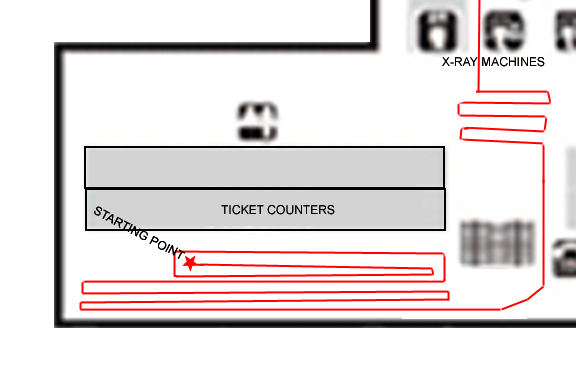
Below, the red line is the path that I had to take to get to the TSA security checkpoint x-rays. Note that the end of the line was inside a coil of people. At one point, I got very concerned that the line I was in was just going around in a long circle. It took me about 90 minutes to get to the x-ray machines.

Once I got through I was tired but happy. I ate some lousy airport food and sat at my gate, trying not to fall asleep waiting for my plane to depart and eavesdropping a "friendly" argument about weapons of mass destruction and the efficacy of the current President.

Moral of the story: Under no circumstances should you fly out of Dulles airport. I could have driven home from the Dulles terminal and gotten back hours before my flight arrived in Raleigh.

some backstory...

More than ten years ago, my roommates brought home over 500 16mm educational films from an auction. I had to work and so wasn't able to attend the auction. I had begged my roommates to buy me a film or two - secretly thinking that they would probably only buy films for themselves since we were all broke, post-college students working crappy jobs. I returned from my job and asked the roommates if they had bought any films. They both grinned and pointed at the large stack of films that I had just walked passed (truth be told, the front room of our house was packed with stuff - band equipment, printing presses, photocopiers, old TVs, etc. - and it was easy to ignore the clutter). Excited, we started watching the films. They had come from North Carolina's Dept of Human Resources and covered a variety of topics - personal hygiene, public health, drug abuse, nutrition, VD, etc.

As I watched each film, something inside of me clicked. It was easy to watch these films and laugh at their dated messages, corny dialogue and low budget production quality, but there was something else here that really stimulated a part of my brain. I would feel the same way whenever I would go to the NC State Univ. library - walking through the stacks and randomly stopping and browsing some arcane trade journal. I would study the beautiful illustrations and advertising and giggle at the trade-specific cartoons I would find in this journals. Here was a glance into an alien world - a whole field of expertise that I just barely even thought about and certainly would never consider being a part of. Watching the newly-acquired, yet obsolete, 16mm films gave me that same thrill - an irrational passion, if you will.

So now, I have over 14,000 such films in my collection. Most of them have come from schools and government agencies. Almost none of them are feature films (theatrical films). Most of them are industrial, educational and almost all are ephemeral (made for a specific audience at a specific time). I periodically show the films and I make them available on DVD and online. But you probably already know that...